We earn a commission if you buy through our links, at no extra cost to you.
Best EV Charger for Tesla: NACS, J1772 and 48 Amps
Choosing a home Level 2 charger for a Tesla: NACS vs J1772, 48 amps on a 60-amp breaker, mixed-brand households and what to ask your electrician.
At a glance
For a Tesla, pick the Tesla Universal Wall Connector: a hardwired 48-amp unit with a NACS handle and a built-in J1772 adapter. The ChargePoint Home Flex suits a J1772 setup with up to 50 amps, and the Emporia EV Charger is the plug-in option at 40 amps.

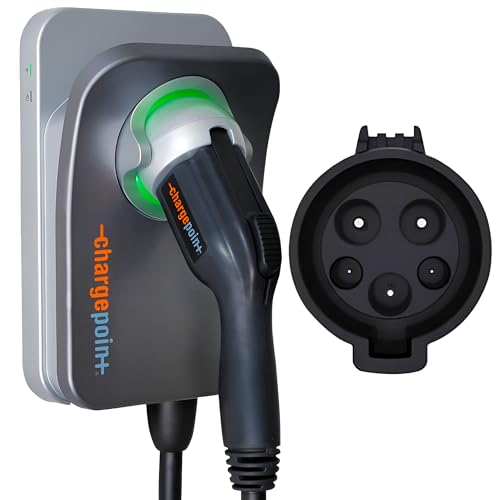

Tesla owners have more home charger choices than they used to, and more questions. Do you need Tesla’s own wall box? Does a J1772 charger from another brand work with your car? What happens when the household also has a non-Tesla EV? This guide walks through the decisions that matter, using the makers’ published specs and government guidance rather than our own use of the products. The specs come from Tesla’s datasheet and installation manual, the other makers’ product pages and the Department of Energy and EPA home charging pages.
For the full field of eight, see our 2026 home EV charger comparison. The short version for a Tesla household is below.
Start With the Connector: NACS or J1772
Tesla’s connector is called NACS, the North American Charging Standard. The Joint Office of Energy and Transportation says several automakers decided to adopt it, and that it worked with SAE on an open standard compatible with NACS, called J3400. The older J1772 connector is still common on non-Tesla EVs and on most Level 2 wall boxes.
In practice, the rule is simple. A charger has to present the connector your car accepts, either natively or through an adapter. None of the pages we consulted says which specific Tesla models ship with a J1772 adapter, so we make no claim about it. Check your owner’s manual or ask Tesla before you buy a J1772-only charger for a Tesla.
Two makers on our list also sell the same charger with a NACS handle. ChargePoint lists NACS versions of the Home Flex, and Emporia offers a NACS version of its Classic charger. The kits we link to from Amazon are the J1772 versions, so a Tesla owner shopping for those two should confirm the connector before checking out.
Tesla Universal Wall Connector: The One-Box Answer
A hardwired 48-amp charger with a NACS handle and a J1772 adapter in the same unit, so it fits a Tesla today and a mixed household later.
The Universal Wall Connector is the charger most Tesla households will look at first, and the sources explain why. According to Tesla’s datasheet, it supports AC charging for vehicles with NACS or J1772 charge ports. The NACS handle is the default, and a J1772 adapter docks into the side of the unit. Tesla’s documentation gives the maximum output as 48 amps, with a Type 3R enclosure, Wi-Fi and the Tesla app. It is certified to UL 2594 and ENERGY STAR, and Tesla’s installation manual describes a 48-month residential warranty.
It is hardwired only. Tesla’s manual says to hardwire branch circuits and not to install cord-and-plug connections, so there is no plug-in option and no sharing of an existing outlet. For the full 48 amps, the manual calls for a 60-amp double-pole breaker. That follows the National Electrical Code’s treatment of EV charging as a continuous load: the Department of Energy’s Alternative Fuels Data Center says Article 625 covers most of the rules, and the breaker is sized at 125 percent of the load. Forty-eight amps times 1.25 is 60 amps.
Our Universal Wall Connector profile covers the cable lengths, part numbers and where Tesla’s datasheet and the ENERGY STAR record disagree on cord length.
ChargePoint Home Flex: A J1772 Option With Adjustable Output
A hardwired 50-amp J1772 kit with Wi-Fi app control and an output you can set to fit your circuit. A NACS version exists, but this button goes to the J1772 kit.
The Home Flex is a different kind of answer. According to ChargePoint, it delivers up to 50 amps and 12 kilowatts through a 23-foot cable, and the app lets you set the output to 16, 24, 32, 40, 48 or 50 amps. That adjustability is useful when your panel cannot spare a large circuit today. It is UL and cUL listed, ENERGY STAR certified and has a Type 3R enclosure, with a three-year parts warranty on the order codes in the datasheet.
For a Tesla owner, the question is the connector. The kit we link to is J1772, and ChargePoint lists a separate NACS version. If you buy the NACS version directly from ChargePoint or elsewhere, you are making a different purchase than the Amazon button here, so compare the order codes in ChargePoint’s datasheet. If you plan to add a second EV with a J1772 port, the J1772 kit is natural. If you want only a NACS handle, choose the NACS version. Our ChargePoint Home Flex profile has the details, including the GFCI breaker note in the datasheet that your electrician should read.
Emporia EV Charger: The Plug-In Route
A plug-in J1772 kit for a NEMA 14-50 outlet, limited to 40 amps as sold, with Wi-Fi scheduling. Emporia also sells a NACS version.
Not every Tesla household wants a hardwired unit, and plug-in is the main reason people look at Emporia. According to Emporia, the Classic delivers up to 40 amps on a NEMA 14-50 plug, or up to 48 amps when hardwired. The kit we link to is the plug-in version with a J1772 connector and a 25-foot cable. Emporia says the plug-in output is limited to 40 amps and that the outlet must be industrial-grade and rated for continuous duty at 50 amps.
Forty amps is 9.6 kilowatts, which is plenty for overnight charging for many drivers, though it is less than the 48 amps the Tesla unit can deliver. Emporia’s page also warns that a GFCI breaker on the circuit can cause nuisance tripping with the charger’s own ground-fault protection, and recommends a hardwired installation if a GFCI breaker is required. That is a conversation for your electrician, because local code and the NEC edition adopted in your area vary. Read the Emporia EV Charger profile for the full list of specs and caveats.
Autel MaxiCharger Home 50A: Another Hardwired J1772 Choice
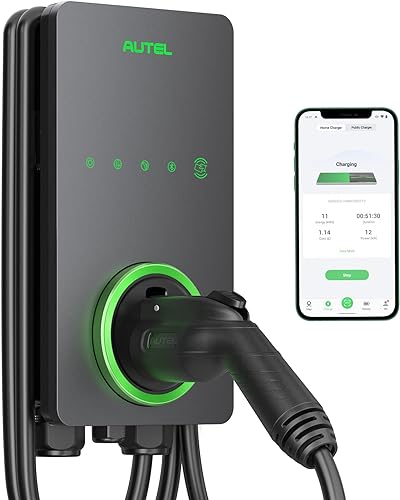
A hardwired 50-amp J1772 charger with a 25-foot cable and Wi-Fi, Bluetooth and Ethernet, for households that want a wired network connection in the garage.
Autel’s 50-amp charger sits in the same class as the Home Flex. According to Autel, it is hardwired, delivers up to 50 amps and 12 kilowatts, and comes with a 25-foot J1772 cable. Autel’s store page says a 70-amp circuit is required for full output, which is a bigger ask of the panel than the 60-amp breaker for the Tesla unit. The store page also lists CSA certification and ENERGY STAR, and the unit has Ethernet in addition to Wi-Fi and Bluetooth.
Because it is J1772, the same connector question applies to a Tesla owner. Our Autel MaxiCharger Home 50A profile notes that Autel’s two sites disagree on the enclosure rating, so confirm the details on the unit you receive.
Mixed Households: A Tesla and Something Else
A growing number of homes have a Tesla and a car from another brand. In that case the connector decision gets easier if the charger covers both ports. The Universal Wall Connector does so with its NACS handle and J1772 adapter, according to Tesla. With a J1772-only charger you would need an adapter for the Tesla, and as noted above, the sources we consulted do not say which Tesla models include one.
If you want two cars to charge at once, the answer depends on your panel more than on the charger. Tesla’s documentation describes group power management, which lets up to six Wall Connectors at the same site share the site’s total available power over Wi-Fi, and says the total current output of grouped units never exceeds the site’s allocation. Our two-car charger guide covers that in more detail.
48 Amps on a 60-Amp Breaker: What Your Electrician Decides
Whichever charger you choose, Level 2 charging needs a dedicated 240-volt circuit. The EPA says an electrician can tell you whether your home has the capacity and can add circuits when needed, and that many areas require permits and inspections. San Diego County’s guidance, for example, says a charger installation needs a building permit, an inspection and a licensed electrician. We do not give wiring steps. We also do not suggest sharing a dryer outlet through a splitter or an adapter: whether an existing 240-volt circuit can serve a charger is something a licensed electrician has to assess.
A few practical points are worth raising with the installer:
- Charge rate versus circuit. Most Tesla owners do not need the full 48 amps every night. The Universal Wall Connector and the Home Flex can both be set lower, which can keep the installation simpler.
- Panel capacity. A 60-amp breaker is a large addition to some panels. A load calculation tells you whether it fits or whether you need a lower setting or an upgrade.
- Cable reach. Tesla’s datasheet lists a 24-foot cable on one part number and a 13.1-foot cable on another, so confirm the length on the listing for your parking spot.
- Permit and inspection. Ask whether your area requires them before the work begins.
Which One Should a Tesla Owner Choose
- Want the simplest fit for a Tesla, now and later: the Tesla Universal Wall Connector.
- Want an adjustable J1772 hardwired charger with a mature app: the ChargePoint Home Flex, with the J1772 or NACS version to match your needs.
- Want plug-in installation on a proper NEMA 14-50 outlet: the Emporia EV Charger, at 40 amps.
- Want Ethernet as well as Wi-Fi: the Autel MaxiCharger Home 50A, with a 70-amp circuit for full output.
If you are still deciding, the home EV charger rankings put the eight chargers side by side. For another angle, our garage charger guide covers enclosure ratings, cable reach and plug-in versus hardwired.
Money: Credits and Rebates
Per the IRS, the section 30C Alternative Fuel Vehicle Refueling Property Credit does not apply to charging equipment placed in service after June 30, 2026, under Public Law 119-21. Check your utility for local rebates, since those programs vary and some have their own rules about which chargers qualify.
Sources
- Universal Wall Connector datasheet, Tesla
- Universal Wall Connector installation manual, Tesla
- Group Power Management overview, Tesla
- Universal Wall Connector ENERGY STAR certification record
- ChargePoint Home Flex specifications and ordering information, ChargePoint
- Emporia EV Charger product page, Emporia
- AC Elite Home 50A EV Charger, Autel Energy store
- SAE J3400 standard, Joint Office of Energy and Transportation
- Charging at home, US Department of Energy Alternative Fuels Data Center
- Getting started with home EV charging, EPA
- Level 2 charger installation, San Diego County EV consumer guide
- Alternative Fuel Vehicle Refueling Property Credit, IRS
Frequently asked questions
Do I need a Tesla-branded charger for my Tesla?
None of the sources we consulted says a Tesla needs a Tesla-branded wall charger. Tesla's own Universal Wall Connector is built around the NACS handle, but other makers sell Level 2 chargers too, some with NACS versions. Check your owner's manual and the charger maker's compatibility notes for your exact car.
What is the difference between NACS and J1772?
They are two charging connector shapes. J1772 is the long-standing standard on non-Tesla EVs. NACS is the connector Tesla developed, which SAE is standardizing as J3400, according to the Joint Office of Energy and Transportation. A charger needs the handle that matches the port, or a correct adapter.
Can the Tesla Universal Wall Connector charge a car that is not a Tesla?
According to Tesla's datasheet, it supports AC charging for vehicles with NACS or J1772 charge ports. It has a NACS handle and a J1772 adapter that docks in the side of the unit, so one wall box can serve a Tesla and a J1772 car.
What breaker does a 48-amp Wall Connector need?
Tesla's installation manual calls for a standard double-pole 60-amp breaker for maximum output, which follows the 125 percent continuous-load rule. The unit can be set lower if your supply cannot support that. A licensed electrician makes that decision after a load calculation.
Should I buy a plug-in or a hardwired charger?
Tesla's manual says to hardwire the Universal Wall Connector and not to use cord-and-plug connections. Plug-in chargers on a NEMA 14-50 receptacle are limited to about 40 amps by their makers, such as Emporia. Both routes need a licensed electrician and, in most areas, a permit.
Can I still claim the federal tax credit for a charger?
Per the IRS, the section 30C credit no longer applies to charging equipment placed in service after June 30, 2026. Check your utility and your state for local rebate programs, since those rules differ by area.