We earn a commission if you buy through our links, at no extra cost to you.
Best EV Charger for Two Cars: Sharing Power at Home
Charging two EVs at home: when one Level 2 charger is enough, which chargers list power sharing, cable reach, panel limits and mixed NACS and J1772 homes.
At a glance
For two EVs, start with one charger and a schedule, then add power sharing if the panel cannot spare two circuits. The Tesla Universal Wall Connector lists sharing for up to six units and fits NACS and J1772 cars. For two J1772 cars that can take turns, one ChargePoint Home Flex on a charging schedule is often enough.


Two EVs in one household raise a practical question that one-car homes never face: how do you charge both without overloading the panel or buying two of everything? This guide relies on the makers’ published documentation and government guidance rather than our own use of the products, and we say where each claim comes from. We only describe power sharing where a maker’s own page describes it. Where a charger has no such feature, we say so.
For all eight chargers, see our 2026 EV charger comparison.
Start With the Basic Question: Do You Need Two Chargers?
Many two-car homes begin by assuming they need two chargers. It is worth checking before you spend money. Level 2 charging is built for overnight sessions, and two cars that park for long stretches can take turns. If each car drives a modest distance on a typical day, one charger can fill one car on one night and the other the next, or you can swap the connector at bedtime. Your own numbers decide this, including each car’s daily mileage and how often both need a full charge on the same night, so we will not put a figure on it.
A charger with app scheduling can make the arrangement easier. The ChargePoint app, the Tesla app and the Emporia app all list scheduling, according to their makers. Scheduling lets a utility’s time-of-use rates work in your favor if you have them, and it gives you a way to prioritize the car that needs the charge. It does not make two cars charge simultaneously from one connector, so a one-charger setup means one car at a time.
If your routine truly needs both cars full every morning, a second charger moves from a luxury to a requirement. At that point the panel matters more than the charger.
The Panel Is the Real Limit
A Level 2 charger runs on a dedicated 240-volt circuit. The Department of Energy’s Alternative Fuels Data Center says EV charging equipment is a continuous load under the National Electrical Code, with Article 625 covering most of the rules, and the circuit is sized at 125 percent of the load. The makers’ manuals follow this: a 48-amp charger calls for a 60-amp breaker, for example. Two such chargers on separate circuits can ask a lot of a home’s electrical service.
The EPA says an electrician can run a load calculation to see whether your home has the capacity and can add circuits when needed, and that permits and inspections are often part of the process. San Diego County’s guidance says a charger there needs a building permit, an inspection and a licensed electrician. We do not give wiring steps. We also do not suggest sharing a dryer outlet with a splitter or adapter: whether any existing 240-volt circuit can serve a charger is for a licensed electrician to decide.
Two ways to ease the panel demand are to set each charger to a lower amperage, which several models allow, and to use a charger that can share a limited supply between units.
Tesla Universal Wall Connector: Sharing for Up to Six Units
The only charger here with a NACS handle and a J1772 adapter in one unit, and Tesla documents power sharing between multiple Wall Connectors at one site.
Tesla’s documentation is the most detailed on this topic. According to the Universal Wall Connector installation manual, a firmware feature called group power management lets up to six Wall Connectors at the same site share the site’s total available power, with the units talking to each other over Wi-Fi. Tesla says the total current of grouped units never exceeds the site’s allocated power, and that this reduces the need for specific electrical upgrades when several vehicles charge at once. During commissioning, each unit is assigned to an individual or shared branch circuit of up to 60 amps. Setting the allocation is a job for your licensed electrician, not a setting to guess at.
The unit is hardwired only, with a 48-amp maximum on a 60-amp breaker, a Type 3R enclosure and a 24-foot cable on one part number, according to Tesla’s datasheet. Our Universal Wall Connector profile lists the part numbers. Two Universal Wall Connectors are the natural setup for a household with two Teslas, a Tesla and a J1772 car, or plans to add a second NACS car later.
Autel MaxiCharger 80A: Load Balancing, With a Big Caveat

Autel lists charger-to-charger Dynamic Load Balancing, but this 80-amp hardwired unit only pays off for EVs that accept more than 48 amps.
Autel’s store page for the MaxiCharger 80A lists two load management options: Adaptive Load Management, which requires compatible additional hardware, and charger-to-charger Dynamic Load Balancing, which Autel says works between chargers without additional hardware. That makes it the second charger on our list with documented two-unit sharing.
The caveat is the charger itself. It is rated up to 80 amps and 19.2 kilowatts and needs a 100-amp circuit for full output, according to Autel. The vehicle sets how much current it accepts, and an 80-amp charger will not charge a car faster than its onboard charger allows. If your cars cap out at 48 amps, you are buying headroom you cannot use, and a 100-amp circuit is a heavy ask of a panel. The page also does not list a UL, ETL or ENERGY STAR mark, so confirm the listing mark with Autel and your electrician before buying. See the Autel MaxiCharger 80A profile for the full details.
ChargePoint Home Flex: One Strong Charger With a Schedule
A hardwired 50-amp J1772 charger with a 23-foot cable and app scheduling, well suited to the one-charger, take-turns approach.
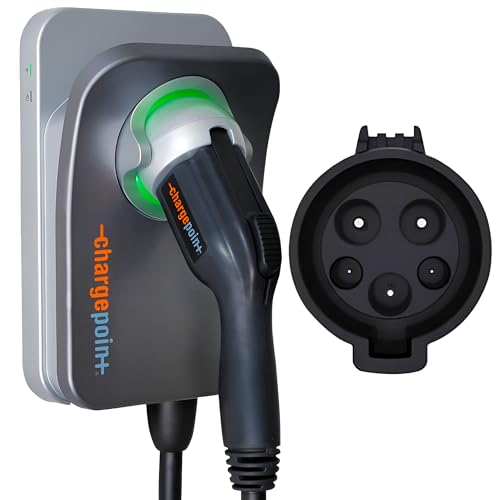
The ChargePoint sources we consulted list no power-sharing feature, so we do not claim one. What the Home Flex does well for a two-car home is the one-charger approach. According to ChargePoint, it delivers up to 50 amps and 12 kilowatts, and its app lets you set the output to 16, 24, 32, 40, 48 or 50 amps, which matters if your panel cannot spare a full circuit today. The datasheet lists a 23-foot cable, UL and cUL listing, ENERGY STAR certification and a three-year parts warranty on the order codes it lists.
For a household with two J1772 cars, mounting one Home Flex where the cable reaches both parking spots can be a sensible first step. If you later want simultaneous charging, you would add a second circuit and a second charger after an electrician’s load calculation. Our ChargePoint Home Flex profile has the specifications.
Emporia EV Charger: Cable Reach, but No Load Management
A plug-in J1772 kit with a 25-foot cable and app scheduling. Emporia says the Classic does not include PowerSmart load management.
Emporia is explicit: the Classic page describes it as the model without PowerSmart load management, and points buyers who want that to the Emporia Pro, a different charger. The Pro is not the product we link to, and we do not describe its specifications.
What the Classic does offer for two cars is a 25-foot cable and a plug-in kit. According to Emporia, the plug-in version is limited to 40 amps, while the hardwired installation allows up to 48 amps. The cable length helps with a driveway or a two-car garage where the charge ports sit at different distances from the wall. For the plug-in version, Emporia says the NEMA 14-50 outlet must be industrial-grade and rated for continuous duty at 50 amps, and it notes that a GFCI breaker can cause nuisance tripping. Raise both with your electrician. The Emporia EV Charger profile covers these points.
If you buy two Emporia Classic chargers, the Classic page does not describe linking them to share power, so ask Emporia if that matters to you. Plan the panel capacity for two full circuits or set the charge rates conservatively.
Cable Reach and Mounting for Two Cars
Even with a single charger, geometry decides how workable the setup is. The cables on the chargers we compare run 23 feet on the ChargePoint Home Flex, 24 feet on the Tesla unit’s longer part number, and 25 feet on the Emporia Classic and the Autel 80A. Measure from the wall location to each car’s charge port with the cars parked as they actually are on an ordinary day. Port position varies a lot from car to car, so a charger that reaches one car’s front corner may not reach another’s rear one.
A few practical points for a shared location:
- Between the spots. A wall between two parking spaces, or a spot near the shared edge of a double garage, often gives the best reach to both ports.
- Cable management. A hook or holster for the cable keeps it off the floor where a car could roll over it. Check each maker’s mounting accessories.
- Outdoor rating. If a driveway wall is in play, check the enclosure rating. Tesla and ChargePoint list Type 3R, Emporia lists NEMA 4, and Autel’s 80A lists IP65 and NEMA 4X. See our garage charger guide for how that plays out.
Mixed NACS and J1772 Households
If one car has a NACS port and the other has a J1772 port, the connector question is part of the charger decision. According to Tesla’s datasheet, the Universal Wall Connector supports AC charging for vehicles with either port type, using the NACS handle or a J1772 adapter that docks in the side of the unit. The Joint Office of Energy and Transportation says SAE is standardizing the NACS connector as J3400, so more cars may arrive with that port over time.
For other chargers, check which connector version the listing sells. ChargePoint and Emporia both offer NACS versions, but the kits we link to are J1772. If you have a Tesla, our guide for Tesla owners covers the connector question in more detail.
Our Picks by Situation
- Two cars that can take turns: one charger and a charging schedule. The ChargePoint Home Flex or Emporia EV Charger fit this approach.
- Two cars charging at once, with panel limits: the Tesla Universal Wall Connector, which documents sharing between units.
- Two vehicles that accept above 48 amps, and a panel that can carry 100 amps: the Autel MaxiCharger 80A, with its load balancing, after checking the listing mark.
- A Tesla and a J1772 car: the Tesla Universal Wall Connector for its built-in adapter.
See how all eight chargers rank for the full picture, and ask your utility about rebates. Per the IRS, the section 30C credit no longer applies to charging equipment placed in service after June 30, 2026.
Sources
- Group Power Management overview, Tesla
- Universal Wall Connector datasheet, Tesla
- MaxiCharger 80A 19.2kW Residential EV Charger, Autel Energy store
- ChargePoint Home Flex specifications and ordering information, ChargePoint
- Emporia EV Charger product page, Emporia
- How your Emporia EV Charger works, Emporia Help Center
- SAE J3400 standard, Joint Office of Energy and Transportation
- Charging at home, US Department of Energy Alternative Fuels Data Center
- Getting started with home EV charging, EPA
- Level 2 charger installation, San Diego County EV consumer guide
- Alternative Fuel Vehicle Refueling Property Credit, IRS
Frequently asked questions
Can one Level 2 charger handle two EVs?
Often yes, if the cars can take turns. A single charger can serve two vehicles when you move the connector between them or let each car charge on a schedule. Whether that is enough depends on how far each car drives each day and how long they are parked. Charge rates and driving habits vary, so work it out for your own routine.
Which chargers on your list can share power between two units?
According to Tesla's documentation, up to six Universal Wall Connectors at one site can share the site's total available power over Wi-Fi. According to Autel's store page, the MaxiCharger 80A supports charger-to-charger Dynamic Load Balancing. None of the other chargers we compare lists such a feature in the sources we consulted.
Does the Emporia EV Charger have load management?
No. Emporia's Classic page describes the Classic as the model without PowerSmart load management and points buyers who want it to the Emporia Pro. If you need load management, ask Emporia directly before you buy the Classic.
Do I need a second circuit for a second charger?
Usually each charger needs its own dedicated 240-volt circuit, and whether your panel can carry both is a question for a licensed electrician. The EPA says an electrician can tell you whether your home has the capacity and can add circuits when needed. Power sharing is one way to reduce what the panel has to supply.
What if one car has a Tesla port and the other has a J1772 port?
The Tesla Universal Wall Connector has a NACS handle and a J1772 adapter that docks in the side of the unit, according to Tesla, so one wall box can serve both. The adapter is a separate piece, so the household has to keep track of it.
Where should I mount the charger for two cars?
Mount it where the cable reaches both charge ports without stretching across walkways. The cables on the chargers here run from 23 to 25 feet, so measure from the wall to each port with the cars parked the way you actually park them, and let your electrician confirm a suitable location.