We earn a commission if you buy through our links, at no extra cost to you.
Comparison
Best EV Chargers of 2026: 8 Level 2 Models Compared
We compared published specs for 8 home Level 2 EV chargers from ChargePoint, Tesla, Leviton, Emporia, Autel and Grizzl-E: amps, plugs, cables and weather ratings.
B By the Best EV Charger editorial team ·Published
At a glance
Start with the ChargePoint Home Flex: a hardwired 50-amp charger with an adjustable output and a mature app. The Tesla Universal Wall Connector adds a NACS handle with a built-in J1772 adapter, and the Leviton EV48W is a hardwired 48-amp option from an electrical brand.
A home Level 2 charger is a wall box that feeds 240-volt power to your car, and the choice has less to do with raw speed than people expect. Your car’s onboard charger decides how many amps it accepts, your panel decides how many amps you can safely supply, and the charger sits between the two. We compared the published specifications of eight models from six brands and ranked them with the strongest all-round, higher-capacity units first and the simpler plug-in chargers toward the bottom.
This ranking rests on manufacturer documentation, ENERGY STAR records and public agencies, not on our own use of the chargers. Every figure below comes from the maker or a named source, and we say so when a claim is the company’s own. Where two official pages disagree, we flag it. Kit details on Amazon can differ from a brand’s other versions, so confirm the connector, cable length and amperage on the listing you plan to buy.
How to Choose
Six questions sort this field quickly.
Your car’s limit. The vehicle’s onboard charger caps the current it accepts. A charger rated above that limit is not faster, only harder to wire for.
Your panel. EV charging is a continuous load under the National Electrical Code, and the Department of Energy’s Alternative Fuels Data Center says Article 625 covers most of the charging-specific rules. In practice the circuit is sized at 125 percent of the charger’s output, so a 48-amp charger calls for a 60-amp breaker per the makers’ manuals. A licensed electrician runs the load calculation.
Plug-in or hardwired. A NEMA 14-50 plug-in model is generally limited to 40 amps. Hardwired units reach 48 amps and above. EPA says chargers rated at 48 amps or higher are usually required to be hardwired.
Connector. Most chargers here use the J1772 connector. The Tesla Universal Wall Connector uses the NACS handle with a built-in J1772 adapter, and the Joint Office of Energy and Transportation notes that SAE standardized NACS as J3400.
Weather and cable. Compare enclosure ratings (NEMA 3R versus NEMA 4) if the charger will hang on an exposed wall, and measure from the wall to your charge port.
Listings. Look for a UL or ETL listing to UL 2594 and ENERGY STAR certification, and ask your electrician and local inspector what they expect.
Installation always starts with a licensed electrician, a permit and an inspection where your area requires them. San Diego County, for example, says a Level 2 charger there needs a building permit and a licensed electrician. We do not give wiring steps.
Comparison Table
#
Model
Max amps
Breaker / circuit
Install
Connector
Cable
Enclosure
Wi-Fi
1
ChargePoint Home Flex
50 A (12 kW)
Dedicated, 125% of load
Hardwired (Amazon kit)
J1772
23 ft
Type 3R
Yes, plus Bluetooth
2
Tesla Universal Wall Connector
48 A
60 A double-pole
Hardwired only
NACS with built-in J1772 adapter
24 ft (13.1 ft version exists)
Type 3R
Yes, 2.4 GHz
3
Leviton EV48W
48 A (11.6 kW)
60 A
Hardwired only
J1772
18 ft
NEMA 3R
Yes
4
Emporia EV Charger
40 A plug-in (48 A hardwired)
50 A (60 A hardwired)
NEMA 14-50 plug-in (Amazon kit)
J1772
25 ft
NEMA 4
Yes
5
Autel MaxiCharger Home 50A
50 A (12 kW)
70 A circuit for full output, per Autel’s store
Hardwired
J1772
25 ft
NEMA 4 (NEMA 4X on Autel’s store)
Yes, plus Bluetooth and Ethernet
6
Autel MaxiCharger 80A
80 A (19.2 kW)
100 A circuit
Hardwired
J1772
25 ft
IP65 / NEMA 4X
Yes, plus Bluetooth and Ethernet
7
Leviton EV40P
40 A (9.6 kW)
50 A
NEMA 14-50 plug-in
J1772
25 ft
NEMA 3R
Yes
8
Grizzl-E Classic 40A
40 A (9.6 kW)
50 A
NEMA 14-50 plug-in
J1772
24 ft
NEMA 4 / UL Type 4
No
Figures come from the manufacturer pages and manuals listed under Sources, and each profile has the details. The Tesla datasheet lists a 24-foot cord while the ENERGY STAR record lists 22 feet, so confirm the length on the listing.
1. ChargePoint Home Flex — Adjustable Power and a Mature App
The most flexible all-round pick for a home with one EV: adjustable output, a mature app and solid listings. Choose it when an electrician will hardwire a dedicated circuit.
What we like
Output adjustable from 16 to 50 amps, so it can match the circuit your electrician installs
UL and cUL listed and ENERGY STAR certified, with a 23-foot J1772 cable, according to ChargePoint
Wi-Fi and Bluetooth app with scheduling and a three-year warranty
Drawbacks
Type 3R enclosure rather than the NEMA 4 rating some rivals list
The Amazon kit is hardwired, so the whole job needs an electrician
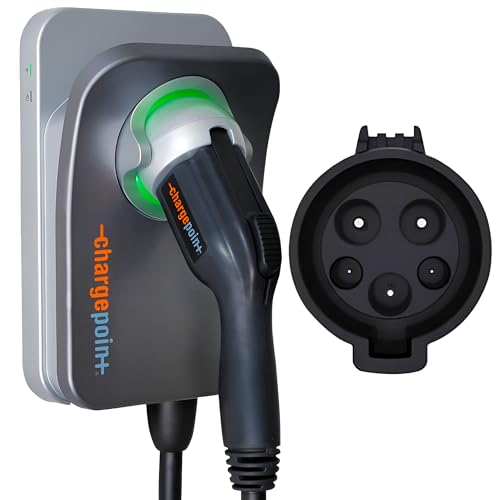
The ChargePoint Home Flex tops the list because it is the most adaptable unit in the group. According to ChargePoint, it delivers up to 50 amps and 12 kW, and the output can be set in the app from 16 amps up to the maximum, so the same charger can match a modest circuit today and a bigger one after a panel upgrade. The Amazon kit is the J1772 hardwired version with a 23-foot cable, Wi-Fi and Bluetooth. ChargePoint lists UL and cUL compliance, ENERGY STAR certification and a three-year parts warranty.
Two caveats keep it from being a perfect fit for everyone. ChargePoint also sells NEMA 14-50 and NEMA 6-50 plug-in versions and NACS versions of the same charger, but the plug-in models are limited to 32 or 40 amps, and the kit we link to is hardwired. Its enclosure is Type 3R, not the NEMA 4 rating some competitors list, according to ChargePoint’s datasheet and an installer write-up by Qmerit. It also has no built-in power sharing between two chargers, per Qmerit.
ChargePoint Home Flex
Our first pick for a one-EV home: output adjustable from 16 to 50 amps, a 23-foot J1772 cable and a mature app, all in a UL listed, ENERGY STAR certified unit.
The Tesla Universal Wall Connector is the only unit here that ships with a NACS handle and a J1772 adapter that docks into the side of the unit. Tesla’s datasheet says it supports AC charging for vehicles with either NACS or J1772 ports, so a Tesla and a J1772 car can share one wall box. It is rated up to 48 amps, uses Wi-Fi with the Tesla app, has a Type 3R enclosure, is certified to UL 2594 and ENERGY STAR, and carries a 48-month residential warranty, according to Tesla and ENERGY STAR.
It is hardwired only. Tesla’s installation manual says not to install cord-and-plug connections, and it calls for a standard 60-amp double-pole breaker for maximum output, though the amperage can be set lower if your supply cannot support that. Tesla also describes group power management that lets up to six Wall Connectors at one site share the available power, which makes it the strongest option here for a two-EV home that expects to add a second unit. It ranks second only because the ChargePoint offers a slightly higher ceiling and more flexibility in the circuit.
Tesla Universal Wall Connector
For Tesla owners and mixed households: a NACS handle with a built-in J1772 adapter, up to 48 amps and power sharing between several units.
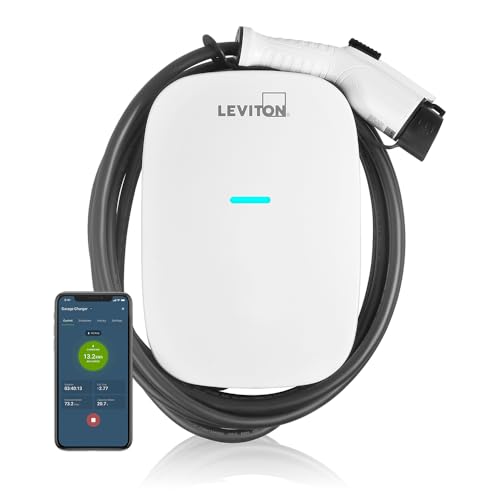
Leviton is a long-established US electrical brand, and the EV48W is its hardwired 48-amp model. Leviton lists 11.6 kW output, an 18-foot J1772 cable, Wi-Fi with the My Leviton app, a NEMA 3R enclosure and a 60-amp breaker. Its compliance list includes UL 2594 and cETLus, and it is OCPP 1.6 compliant, which matters if you ever want to connect to a network that supports that protocol.
The trade-offs are modest. The 18-foot cable is the shortest in this comparison, so measure the distance from the wall to your charge port with the car parked where it usually sits. The warranty is two years limited, shorter than most rivals here. It sits third because the Tesla and ChargePoint offer more cable and longer coverage, but for a buyer who values a familiar electrical name and a clean 48-amp hardwired install, it is a solid choice.
Leviton EV48W
For buyers who want a hardwired 48-amp charger from an established electrical brand, with Wi-Fi, OCPP 1.6 and UL 2594 plus cETLus listings.
The Amazon kit for the Emporia EV Charger is the plug-in version: a NEMA 14-50 connection, a J1772 connector and a 25-foot cable. Emporia says the plug-in installation limits the charge rate to 40 amps, while the hardwired installation allows 48 amps. It lists a NEMA 4 enclosure for indoor and outdoor use, UL 2594, ENERGY STAR certification, a Wi-Fi app and a three-year warranty.
Emporia is direct about the outlet. It says a plug-in installation needs an industrial-grade outlet rated for continuous duty at 50 amps, and that a standard residential outlet is not built for nightly charging. That is electrician territory. Emporia also states that the Classic model lacks PowerSmart load management, which it sells on the separate Emporia Pro, so this is not the unit for balancing two chargers. It ranks fourth because its 40-amp plug-in output trails the hardwired units above it, and the 48-amp version needs a hardwire installation.
Emporia EV Charger
For a garage with a properly installed NEMA 14-50 outlet: a plug-in kit with a 25-foot cable, a NEMA 4 case and app scheduling.
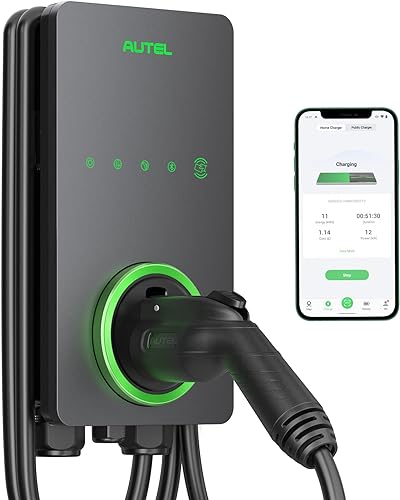
The Autel MaxiCharger Home 50A on Amazon is the hardwired model with an in-body holster, meaning the connector docks in the charger body instead of a separate holster. According to Autel, it delivers 50 amps and 12 kW over a 25-foot J1772 cable, and connects by Wi-Fi, Bluetooth and Ethernet. The wired Ethernet port is useful where the garage has a weak Wi-Fi signal. Autel’s three-year limited warranty applies, and its store page states CSA and ENERGY STAR certification.
Autel’s own pages are not fully consistent. The autelenergy.us page lists a NEMA 4 enclosure while the Autel store lists IP65 and NEMA 4X, and the store page calls for a 70-amp circuit for full output. Because of those differences and the less common circuit size, we rank it fifth and suggest asking your electrician to confirm the details against Autel’s installation documents.
Autel MaxiCharger Home 50A
For a hardwired 50-amp setup with Ethernet, a 25-foot cable and an in-body holster that keeps the connector docked in the unit.
The Autel MaxiCharger 80A is the most powerful charger in this group: 80 amps and 19.2 kW, hardwired, with a 25-foot J1772 cable, Wi-Fi, Bluetooth and Ethernet, an IP65 and NEMA 4X enclosure and a five-year warranty. Autel’s store page says full output needs a 100-amp circuit and lists Dynamic Load Balancing between chargers.
Power only matters if the car can use it. A vehicle whose onboard charger accepts 48 amps will not charge faster on 80 amps, so this unit suits a small set of vehicles that accept more, and you should confirm that in your owner’s manual. Autel’s store page also does not list a UL, ETL or ENERGY STAR mark, so confirm the listing mark with Autel and with your electrician before you buy. Those two conditions are why it ranks sixth despite the headline numbers.
Autel MaxiCharger 80A
A specialist 80-amp unit for the few EVs whose onboard charger accepts more than 48 amps; needs a 100-amp circuit and a listing check.
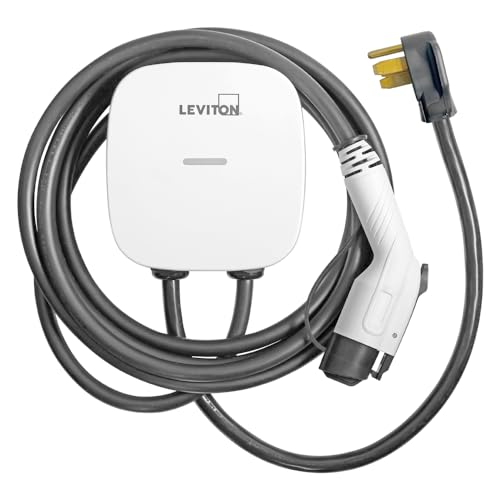
The Leviton EV40P is the plug-in member of Leviton’s EV Series: 40 amps and 9.6 kW, a 25-foot J1772 cable and a pre-attached 3-foot cord with a NEMA 14-50P plug. Leviton lists a NEMA 3R enclosure, UL 2594, Wi-Fi with the My Leviton app and a 50-amp breaker. The warranty is two years limited.
It is a tidy fit for a home that already has a properly installed 14-50 receptacle, and the plug lets you take it with you if you move. A car that can take 48 amps will be limited to 40 here. That, along with the shorter warranty, puts it seventh. If an existing 240-volt circuit in your garage might serve a charger, only a licensed electrician can say so, and we do not recommend adapters or splitters.
Leviton EV40P
For a home with an existing, properly installed outlet: a 40-amp plug-in charger with a 25-foot cable and Wi-Fi from a familiar electrical brand.
The Grizzl-E Classic, made by United Chargers, is deliberately simple. According to the manual, it delivers 40 amps and 9.6 kW, can be dialed down to 16 amps, uses a NEMA 14-50 plug and a 24-foot J1772 cable, and has no user interface. ENERGY STAR lists its network connection as none. Its aluminum enclosure is rated NEMA 4 in the manual, and the manufacturer lists UL listing and ENERGY STAR certification with a three-year or five-year warranty option.
There is no Wi-Fi and no app, so scheduling has to come from the car or your utility’s rate plan. If you do not care about an app, that is a plus, and it is why this unit is our budget-minded pick. It ranks last only because it offers the least power and the fewest features, not because of any weakness in the build.
Grizzl-E Classic 40A
For drivers who want a durable plug-in charger with no app or account: 40 amps, a 24-foot cable and a NEMA 4 aluminum case.
One EV, hardwired. The ChargePoint Home Flex is our first choice, with the Leviton EV48W as the electrical-brand alternative if you want a plain 48-amp unit.
Tesla or a mixed household. The Tesla Universal Wall Connector covers NACS and J1772 in one box and supports power sharing between several units.
Plug-in on a NEMA 14-50 outlet. The Emporia EV Charger adds a NEMA 4 case and app scheduling, the Leviton EV40P is the simpler Wi-Fi option, and the Grizzl-E Classic 40A skips the app entirely. Have a licensed electrician install the outlet and confirm it is rated for continuous use.
Weak Wi-Fi in the garage. The two Autel models add an Ethernet port. ChargePoint says its station stores session data locally if the connection drops, but ask each maker what works offline.
A car that accepts more than 48 amps. Only then does the Autel MaxiCharger 80A make sense, with a 100-amp circuit and a confirmed listing mark.
Safety, Permits and the Federal Credit
Every unit here runs on a dedicated 240-volt circuit installed by a licensed electrician with the permit and inspection your area requires, as the Department of Energy and EPA both advise. Look for a UL or ETL listing and ENERGY STAR certification, and ask the manufacturer for anything the product page does not state. We do not recommend sharing a dryer outlet through splitters or adapters.
As for incentives, the IRS says the section 30C credit does not apply to charging equipment placed in service after June 30, 2026. Check your own utility for rebates or time-of-use rates, which differ by location.
Based on the published specs, we rank the ChargePoint Home Flex first because its output can be set between 16 and 50 amps in the app, it is UL listed and ENERGY STAR certified, and it comes with a mature app. The Tesla Universal Wall Connector is a close second, especially if you drive a Tesla or have both Tesla and J1772 cars.
Do I need an electrician to install a Level 2 charger?
Yes. The Department of Energy and EPA both say Level 2 charging needs a dedicated 240-volt circuit and point homeowners to a licensed electrician, who handles the load calculation, permit and inspection. This applies to plug-in models too, because a new NEMA 14-50 outlet is also electrical work.
Why does a 48-amp charger need a 60-amp breaker?
EV charging is a continuous load under the National Electrical Code, and Article 625 sizes the circuit at 125 percent of the load. That is why Tesla and Leviton call for a 60-amp breaker with a 48-amp charger, and why a 40-amp plug-in charger like the Leviton EV40P calls for 50 amps.
Is a plug-in or hardwired charger better?
Plug-in models on a NEMA 14-50 outlet are generally limited to 40 amps and are easier to swap or take with you, while hardwired models can go to 48 amps and above. EPA notes that chargers rated at 48 amps or higher are usually required to be hardwired. Your electrician decides what fits your panel and local code.
Can I use my dryer outlet for a charger?
Whether an existing 240-volt circuit can serve a charger is a question for a licensed electrician, who will look at the circuit, wiring and outlet. We do not recommend splitters or adapters that share a circuit with another appliance.
Is there still a federal tax credit for home chargers?
According to the IRS, the section 30C credit does not apply to charging equipment placed in service after June 30, 2026. Check your utility and state for separate rebate programs, which vary by location.