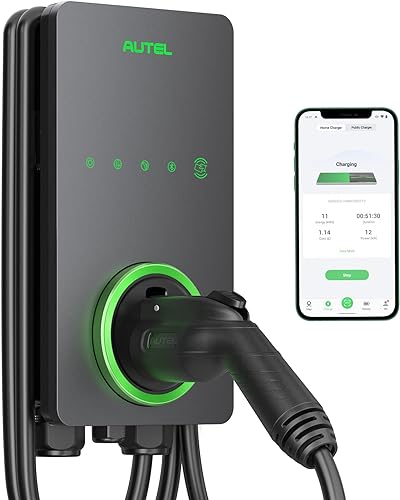
The Autel MaxiCharger Home 50A, sold by Autel Energy as the MaxiCharger AC Elite Home 50A with an in-body holster, is a hardwired Level 2 charger that tops out at 50 amps. It sits near the middle of the eight chargers on this site and is one of the more connected ones: Wi-Fi, Bluetooth and Ethernet are all on the spec sheet. If you want to place it against the field, start with our home EV charger rankings for 2026. Two neighbors worth a look are the bigger Autel MaxiCharger 80A and the ChargePoint Home Flex, which also offers a hardwired 50-amp configuration.
This profile draws on Autel’s published product pages and public guidance on home charging, not on our own use of the charger, and we say which source each claim comes from. Where Autel’s two official sites differ, we show both versions rather than pick one.
The Short Version
According to Autel, this is a 240 V, 50 A Level 2 charger with a 12 kW maximum output and a 25-foot SAE J1772 cable. It is hardwired, meant for indoor or outdoor mounting, and managed through the Autel Charge app. The in-body holster means the connector docks inside the unit instead of hanging on a separate bracket.
Autel’s store page for the AC Elite family says the output can be adjusted in the app to suit your installation.
Key Specs According to Autel
- Connector: SAE J1772, 25-foot cable (autelenergy.us).
- Maximum current and power: 50 A, 12 kW (autelenergy.us).
- Input: Hardwired (autelenergy.us).
- Connectivity: Wi-Fi, Bluetooth, Ethernet, CAN and RS485 (autelenergy.us).
- Enclosure: NEMA 4 on autelenergy.us; IP65 / NEMA 4X on Autel’s store page for the AC Elite Home 50A.
- Dimensions: 7.36 inches wide, 13.23 inches high, 3.35 inches deep (autelenergy.us).
- Status indication: LED and app (autelenergy.us).
- Operating temperature: minus 40 to 131 degrees Fahrenheit (Autel store page).
- Circuit for full output: 70 A (Autel store page).
- Warranty: Three years, limited (both Autel pages).
- Certifications: CSA certified and ENERGY STAR certified, per Autel’s store page.
Why the Holster Matters
Autel sells this charger in two forms: one with a separate holster you mount beside the unit, and one with an in-body holster. The in-body version is the one on the Amazon listing, and it is the one this profile covers. The connector parks in the charger body, and Autel describes the design as including cable management.
In a tight garage, that is a practical difference. There is one thing to mount instead of two, and the nozzle sits in a protected spot when you are not charging. The tradeoff is size: the body has to hold the connector and the coiled slack, so check the dimensions above against the wall space you have. If you would rather have a separate holster, Autel’s own lineup includes that version, but it is a different product from the one on this page.
Power, Circuit and Code
A 50 A charger is not a plug-and-play appliance. The U.S. Department of Energy’s Alternative Fuels Data Center notes that EV charging equipment is treated as a continuous load under the National Electrical Code and points to Article 625 for the rules that apply, and it adds that permits may be required. The trade publication EC&M describes the 125 percent rule for continuous loads: you multiply the equipment’s maximum load by 125 percent when sizing the branch circuit. Autel’s 70 A figure for full output fits that math.
What this means for you: have a licensed electrician check your panel, run a load calculation and pull the permit. The EPA’s home charging guidance says to hire an electrician for a new charger and says an electrician can tell you whether your panel has the capacity, and San Diego County’s charger page says an EV charger installation requires a building permit, is subject to inspection and must be done by a licensed contractor. The rules in your town may differ, so ask your local building department.
Because this model is hardwired and set up through the app, the circuit and the output setting are decisions for you and your electrician together. A 50 A charger on a smaller circuit can be set to a lower output, which is why the adjustable range matters. Do not try to adapt it to an existing outlet, and do not share a dryer circuit: whether any existing 240 V circuit can serve a charger is something only an electrician can judge after looking at the panel.
Does Your Car Use 50 Amps?
The charger sets a ceiling, but the car decides how much it takes. Some vehicles accept far less than 50 A, and a 50 A charger would never reach full output on them. An adjustable charger works like this: it supplies what the vehicle asks for, up to the limit you set. Your owner’s manual lists the maximum AC charging rate. If your car accepts less than 40 A, you can avoid a larger circuit by choosing a 32 or 40 amp model such as the Leviton EV40P.
App, Scheduling and Access Control
According to Autel, the Autel Charge app handles starting and stopping a session, monitoring, scheduling and adjusting the current. Scheduling matters if your utility has time-of-use rates, since you can push a charge into the overnight window. Check your utility’s rate plan for what that window is.
Autel also lists RFID card access on its store page, with the cards sold separately, and describes the charger as able to take part in load management with other Autel units. Confirm the exact feature set with Autel if you plan to run two units on one circuit.
Weather and Placement
Both Autel pages say the unit is built for indoor or outdoor use, and the autelenergy.us page recommends hardwiring for outdoor installation. The enclosure rating is where the pages differ: NEMA 4 on one, IP65 and NEMA 4X on the other. Both describe a weather-protected enclosure, but if you are mounting in a coastal area or somewhere that sees hose spray, ask Autel which rating applies to the unit shipping today. The Department of Energy says outdoor installations require outdoor-rated equipment.
Pros and Cons
What stands out
- Up to 50 A and 12 kW in a hardwired unit, with adjustable output.
- In-body holster keeps the nozzle and cable tidy.
- Wi-Fi, Bluetooth and Ethernet, which gives you a wired option if the garage Wi-Fi is weak.
- Three-year warranty.
What to weigh
- Needs a 70 A circuit for full output, which can mean a panel upgrade.
- No plug-in option on this version: it is hardwired only.
- Conflicting enclosure ratings on Autel’s two sites.
- Autel’s own pages describe the product under different names, which makes it harder to match a manual or spec sheet to the unit you buy. Match the part number and keep the paperwork.
How It Compares
Next to the ChargePoint Home Flex, which also reaches 50 A hardwired, the Autel adds Ethernet and an in-body holster. Against the Autel MaxiCharger 80A, the 50 A model asks for far less of your panel and suits more vehicles. Against a plug-in 40 A charger, it is a step up in output but a step down in flexibility, because it cannot be unplugged and moved.
Who Should Buy It
This charger suits a homeowner with a vehicle that accepts more than 40 A, a panel with room for a 70 A circuit, and a wish for app scheduling with a wired network option. It also suits someone who prefers a hardwired install for an outdoor wall.
Who Should Skip It
Skip it if your car’s onboard charger is limited to a lower rate, if your panel cannot support the circuit, or if you want to take the charger with you when you move. A smaller plug-in model may avoid a circuit upgrade, which your electrician can confirm.
Before You Buy
- Look up your car’s maximum AC charging rate in the owner’s manual.
- Ask a licensed electrician to check panel capacity and quote the circuit.
- Confirm the certification mark on the unit you receive with Autel, and ask your electrician and local inspector which marks they accept.
- Check your utility for rebates; amounts and rules vary by utility. Per the IRS, the federal section 30C credit does not apply to charging equipment placed in service after June 30, 2026.
- Measure the distance from the mounting spot to the charge port against the 25-foot cable.
You can check the current listing and price at Autel MaxiCharger Home 50A on Amazon.
See how it compares with the other seven chargers in our EV charger rankings for 2026.
Sources