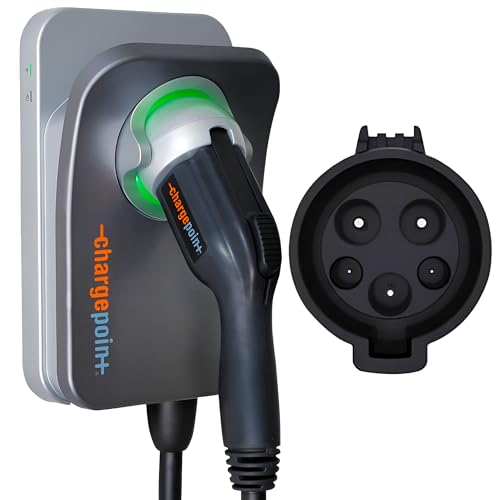
The ChargePoint Home Flex is a Level 2 home charger built around one idea: you set the charging speed in an app to fit the circuit your home can supply. It is the number one pick in our 2026 EV charger comparison, and the Amazon kit we link to is the hardwired, 50-amp version with a 23-foot J1772 cable. If you want a Tesla-built alternative, read our profile of the Tesla Universal Wall Connector. If you prefer a hardwired charger from an electrical brand, see the Leviton EV48W.
This profile draws on published sources, not on our own use of the charger. The specs come from ChargePoint’s datasheet and documentation, with commentary from an installer’s write-up by Qmerit, which we credit by name.
The Short Version
According to ChargePoint, the Home Flex delivers up to 50 amps and 12 kW, uses a 23-foot cable, connects over Wi-Fi, and is controlled from the ChargePoint app. The charger is UL and cUL listed, ENERGY STAR certified, and carries a three-year parts warranty on the order codes in the datasheet. In plain terms, it is a mainstream, mature product that suits a household with one EV, a garage or carport wall, and an electrician who can run a dedicated circuit.
It is a good pick when you want an app and a long-established charging brand. It is a less obvious pick if you plan to charge two cars from one panel at the same time, because Qmerit says it has no built-in power sharing.
Key Specs According to ChargePoint
- Power: Maximum 12 kW (240V AC times 50A). The output can be set through the app to 16, 24, 32, 40, 48 or 50 amps.
- Connector and cable: SAE J1772 on the Amazon kit, 23 feet (about 7 meters). ChargePoint also lists NACS versions.
- Installation options: Hardwire, NEMA 14-50 or NEMA 6-50. The NEMA models are limited to 32 or 40 amps of output.
- Breaker: A dedicated double-pole breaker rated at 125 percent of the maximum load. ChargePoint’s example is a 50-amp breaker for 40 amps of output.
- Connectivity: 2.4 and 5 GHz Wi-Fi, plus Bluetooth for setup, with over-the-air firmware updates.
- Enclosure: Type 3R per UL 50E, indoor or outdoor.
- Operating temperature: minus 22 to 122 degrees Fahrenheit, according to the datasheet.
- Listings: UL and cUL listed, complies with UL 2594 and UL 2231, NEC Article 625 compliant, FCC Part 15 Class B, and ENERGY STAR certified.
- Weight: 13.8 pounds, according to the datasheet.
- Warranty: Three years on parts, according to the order codes in the datasheet.
What You Get for the Speed
The headline number is the 50-amp ceiling. ChargePoint’s documentation says that compared with a standard wall outlet it can charge up to nine times faster and add up to 37 miles of range per hour. That is a best-case figure. The actual rate depends on your car, because the vehicle’s onboard charger decides how much current to accept. A car limited to 32 amps will not benefit from the extra headroom, but the headroom costs you nothing if your electrician is already installing a 60-amp circuit.
Where this charger earns its name is the adjustability. The app lets you pick a lower amperage if your panel cannot support the full 50 amps today, and raise it later if the electrical service is upgraded. ChargePoint’s documentation says drivers can change the charging speed from 16 amps to 50 amps to fit their demands and the capacity of their residence. The decision about what your home can support belongs to a licensed electrician after a load calculation, as EPA’s home charging guidance explains.
The ChargePoint App and Smart Features
The Home Flex is managed through the ChargePoint mobile app. According to ChargePoint’s documentation, the app is how you set the output amperage, and the datasheet lists app-based installation software for iOS and Android. Qmerit’s write-up adds that the app can schedule charging to take advantage of lower-cost electricity, tracks energy use, and shows session history. It also says the charger works with Amazon Alexa and Google Home, and supports solar integration.
The datasheet gives some practical details that matter if your internet is flaky. The station stores up to 90 days of session data locally, in a capacity of about 100 sessions, if the connection drops. It also keeps itself current through over-the-air firmware updates. Those updates require a connection, so a garage with a weak Wi-Fi signal is worth sorting out before the electrician finishes.
Qmerit also points out that ChargePoint offers around-the-clock customer support and that the holster swivels and has a light, which it calls helpful in dark garages. Those are manufacturer-adjacent observations from an installer, so treat them as helpful context rather than independent confirmation.
Installation and Safety
This is a hardwired charger, so the installation is electrical work on a dedicated 240V circuit. Level 2 charging needs that circuit, and both the US Department of Energy and EPA say to involve an electrician. The Department of Energy’s Alternative Fuels Data Center says charging equipment installations must comply with local and state codes, that permits may be required, and that EV charging is a continuous load under the National Electrical Code, with Article 625 covering most of the charging-specific rules. ChargePoint’s datasheet reflects that: it calls for a breaker rated at 125 percent of the maximum load.
The datasheet also says an external GFCI breaker can conflict with the charger’s internal ground-fault protection (a 20 mA CCID), and that hardwired installations should use a non-GFCI breaker. We are not suggesting any installation approach here. The point is that your electrician should read ChargePoint’s installation documents and local code before choosing the breaker, and the permit and inspection should happen before you use the charger. San Diego County’s EV guide, for example, says a Level 2 charger there requires a building permit, an inspection and a licensed electrician.
For hardwired versus plug-in, EPA says chargers rated at 48 amps or higher are usually required to be hardwired, while an outlet makes it easier to swap chargers without an electrician. If you want the plug-in version for flexibility, ChargePoint caps the NEMA models at 32 or 40 amps.
Weather and Placement
ChargePoint lists a Type 3R enclosure per UL 50E and an operating range of minus 22 to 122 degrees Fahrenheit, so the charger is meant for garages and outdoor walls. Qmerit notes that the Home Flex is rated Type 3 rather than NEMA 4, which means it handles rain and sleet in normal conditions but is not as protected against sustained, direct rainfall as some competitors. If your charging spot is an exposed wall in a rainy region, compare enclosure ratings across models, which is one reason we flag the NEMA 4 rated options in our comparison.
Qmerit also describes a cold-weather check: its contributor reports that the cable stayed pliable after 14 hours in a commercial freezer at minus 18 degrees Fahrenheit. That is one third-party observation, not a promise, but it is relevant if your garage is unheated.
On cable length, the 23-foot cord is a reasonable length for most driveways and garages, but measure from the wall to your charge port with the car parked in its usual spot. Some EVs have the port on a rear fender, and a port on the side facing away from the wall can change the answer.
Pros and Cons
What we like, according to the sources:
- Wide amperage range through the app, from 16 to 50 amps, so the charger can match the circuit.
- UL and cUL listed, ENERGY STAR certified, and NEC Article 625 compliant, according to ChargePoint.
- A mature app with scheduling, history and smart-home voice assistant support, per Qmerit.
- A NACS version of the same product and a conversion kit, which helps if your next car changes connectors.
- A three-year parts warranty on the datasheet order codes.
What to weigh:
- No built-in power sharing, per Qmerit, so two cars means two independent circuits.
- Type 3R rather than NEMA 4, so exposed wet locations deserve a second look.
- The plug-in models are capped at 32 or 40 amps, and the 50-amp output is the hardwired model.
- It is a hardwired product on the Amazon page, so you need an electrician for the whole job, not just the charger.
How It Compares
Against the Tesla Universal Wall Connector, the Home Flex trades a built-in NACS handle for a wider amperage range and the ChargePoint app. The Tesla unit tops out at 48 amps and supports sharing between several units. Against the Leviton EV48W, the ChargePoint offers higher maximum power, a longer cable and a longer warranty on paper, while Leviton points to more than a century in US homes and to OCPP 1.6 compliance. See the full ranking in our EV charger comparison for 2026.
Who Should Buy It
- A household with one EV that wants a polished app and flexible speed.
- Homeowners whose electrician will hardwire a dedicated circuit and who like the idea of adjusting amperage later.
- Drivers with a J1772 car, or an upcoming NACS car, who want the option of either connector in the same product family.
Who Should Skip It
- Households that want two chargers to share one circuit automatically. Look at the Tesla unit, which supports sharing between several of its own chargers.
- Anyone installing on a wall that takes direct, heavy rain, who wants a NEMA 4 enclosure.
- Renters or anyone who needs a unit they can unplug and take with them. The Amazon kit is hardwired.
Before You Buy
- Confirm your car’s charge port: J1772 or NACS.
- Ask a licensed electrician to run the load calculation, pull the permit and set the breaker size.
- Decide whether you need the full 50 amps or whether your car would never accept that much.
- Check your local utility for rebates and time-of-use rates that the scheduling feature can use. Per the IRS, the federal section 30C credit no longer applies to equipment placed in service after June 30, 2026.
You can check the current listing and price at ChargePoint Home Flex on Amazon.
Sources