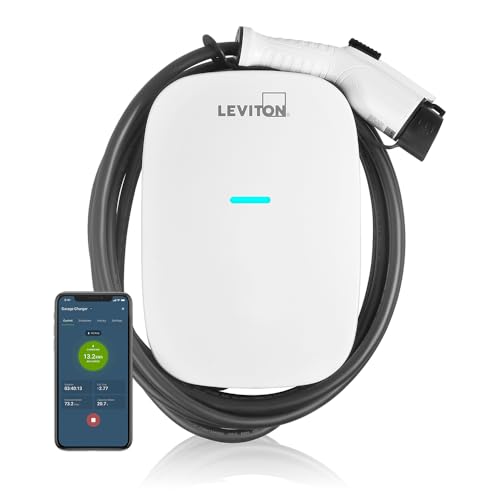
The Leviton EV48W is a smart, hardwired Level 2 charger from one of the best-known names in US residential wiring. It is rated for 48 amps and 11.6 kW, uses an 18-foot J1772 cable, connects over Wi-Fi to the My Leviton app, and lists OCPP 1.6 compliance. It is the number three pick in our 2026 EV charger comparison. If you prefer a plug-in charger from the same maker, read our profile of the Leviton EV40P. For a hardwired charger with a longer cable and a wider amperage range, compare the ChargePoint Home Flex.
This profile draws on published sources, not on our own use of the charger. The specs come from Leviton’s own product page for the EV48W and the Leviton residential EV charger brochure. Those pages are our only manufacturer sources, so everything specific to this model below comes from the brand, and we say so wherever it matters.
The Short Version
According to Leviton, the EV48W is a 48-amp, 208/240 volt station with 11.6 kW of output, a J1772 connector, an 18-foot cord, a mounting bracket, and a pre-attached input cable. The product page describes a water-resistant NEMA Type 3R enclosure, a cable designed to resist freezing and cracking, Wi-Fi, support for the My Leviton app, and optional RFID control. It is listed to UL 2594 and cETLus, and Leviton also describes it as UL and ENERGY STAR certified. The warranty is two years limited.
If your electrician is already hardwiring a 48-amp circuit and you like the idea of a charger from the same brand as your switches and breakers, this is a sensible pick. If you need a long cable or a long warranty, other models in our lineup are better matches.
Key Specs According to Leviton
- Current and power: 48 amps, 208/240 VAC, 11.6 kW output.
- Breaker: 60 amps, according to the product page.
- Connector and cable: SAE J1772, 18 feet (5.5 meters), 7 AWG conductors in the cord.
- Installation: Hardwired only, with a mounting bracket and a pre-attached input cable included. Bottom feed.
- Connectivity: Wi-Fi (802.11 b/g/n) and the My Leviton app. Optional RFID control.
- Standards: UL 2594, UL 2231-1, UL 2231-2, UL 2251, UL 62, UL 991, UL 1998, NFPA 70 Article 625, UL 840 and CSA C22.2 No. 280, plus cETLus and OCPP 1.6 compliance.
- Ground-fault protection: 20 mA CCID per UL 2231.
- Enclosure: NEMA Type 3R, plastic.
- Operating temperature: Minus 30 to 50 degrees Celsius (minus 22 to 122 degrees Fahrenheit), with the same range for the charging cable.
- Altitude: Up to 6,500 feet.
- Warranty: 2-year limited.
Who Leviton Is, and Why It Matters Here
Leviton says it has been in homes for over a century and has been working on EV charging for over a decade. Brand history is not a technical spec, but it does matter in one practical way: electricians and homeowners are likely to know Leviton breakers, outlets and smart switches, and the company has a 24/7 support team according to its product page. That may be reassuring to a homeowner who is buying a charger for the first time.
The EV48W also fits into Leviton’s smart-home pitch. The product page says it works with the My Leviton app via Wi-Fi, so you can take control of your entire home, from the load center to lighting to the EV charger. If you already use Leviton smart devices, that could mean fewer apps on your phone. The sources we consulted give no detail on app features such as scheduling or usage graphs, so we cannot describe them. Check the My Leviton app description before you buy if scheduling is important to you.
Hardwired, 48 Amps, and the Panel Question
The EV48W is hardwired only, and Leviton’s page says it requires a 60-amp breaker. That is the 125 percent sizing that applies to EV charging as a continuous load. The Department of Energy’s Alternative Fuels Data Center says EV charging infrastructure is considered a continuous load under the National Electrical Code and that NEC Article 625 contains most of the charging-specific rules. Leviton lists NFPA 70 Article 625 among the standards for this station.
EPA’s guidance adds that chargers rated at 48 amps or higher are usually required to be hardwired instead of plugged into an outlet. That is consistent with how Leviton sells this unit. The same EPA page tells homeowners to hire an electrician for a new charger, and says the electrician can perform a load calculation to find out whether your panel can handle the charger or needs upgrades, and obtain permits and inspections. San Diego County’s EV guide says a Level 2 installation there requires a building permit, an inspection before use, and a licensed electrician.
We do not give wiring steps here. If you are wondering whether an existing 240V circuit, such as one that serves another appliance, can be reused, ask your electrician. We do not suggest splitters or adapters.
Weather, Cold and Placement
Leviton says the water-resistant enclosure is rated NEMA Type 3R and the cable is designed to prevent freezing and cracking in extreme weather, so the unit can be installed indoors or outdoors. The Leviton brochure says the stations can be installed anywhere from garages to outdoor parking spaces with the mounting bracket or an optional pedestal. The stated operating range is minus 30 to 50 degrees Celsius.
NEMA 3R is common among home chargers, and it differs from NEMA 4, which some competitors list. If your charger will sit on a wall that takes sideways rain or hose spray, compare enclosure ratings across models. Our comparison shows which models list it.
The 18-foot cable is the main placement constraint. Park the car where you normally do, measure from the planned mounting spot to the charge port, and add a margin for turns and slack. Cars with a rear or driver’s side port can need more reach than the number suggests. Leviton also lists an optional dual-mount pedestal for the EV Series, with front and back mounting, if a wall is not available.
Access Control and OCPP
The EV48W includes optional RFID control. Leviton’s brochure says all stations ship with RFID disabled, and that users can prevent unauthorized use by tapping an RFID card to activate the station if they turn the feature on. For a driveway where neighbors might be tempted to plug in, that may be a useful extra, though we recommend checking what RFID cards are included with this specific model before you buy.
Leviton also lists compliance with OCPP 1.6, an open protocol that charging networks use to manage chargers. For a typical single-family home this is a bonus rather than a necessity, but it can matter for a shared garage, a small multifamily property or a landlord who wants to manage access.
Pros and Cons
What we like, according to the sources:
- Hardwired 48 amps and 11.6 kW with a pre-attached input cable and mounting bracket.
- Wi-Fi and a smart-home app from a recognizable electrical brand.
- Optional RFID access control and OCPP 1.6 compliance.
- A broad list of UL standards, plus cETLus, on the product page.
- A cable designed for cold weather, per Leviton.
What to weigh:
- An 18-foot cable, shorter than the 23 to 25 feet on the other hardwired chargers in our lineup, apart from Tesla’s optional 13.1-foot version.
- A 2-year limited warranty, shorter than the three-year or four-year coverage on some rivals.
- No NACS handle, so a Tesla owner needs a Tesla-supplied adapter, per Leviton.
- No detailed app feature list in the sources we consulted.
How It Compares
Against the ChargePoint Home Flex, the Leviton gives up two amps of maximum output, five feet of cable and a year of warranty (a two-year term against ChargePoint’s three), in exchange for OCPP support and a brand that many electricians already stock. Against the Tesla Universal Wall Connector, both are hardwired 48-amp units, but the Tesla adds a native NACS handle and group power management, while the Leviton is a J1772 charger. For plug-in installations on a NEMA 14-50 outlet, look at the Leviton EV40P.
Who Should Buy It
- Homeowners who want a hardwired 48-amp charger and like a familiar electrical brand.
- Households with Leviton smart-home gear who want one app.
- Garages or small properties that may want RFID access and OCPP compatibility.
Who Should Skip It
- Drivers who need more than 18 feet of reach.
- Households that want built-in power sharing for two cars. Leviton’s pages list no sharing feature for this model.
- Anyone who wants a plug-in charger. This model is hardwired only.
Before You Buy
- Measure from the mounting spot to your charge port.
- Confirm the connector: J1772 for most EVs, or a Tesla-supplied adapter for a Tesla.
- Ask a licensed electrician about the 60-amp circuit, the permit and the inspection.
- Per the IRS, the federal section 30C credit no longer applies to equipment placed in service after June 30, 2026. Check your utility for local rebates.
You can check the current listing and price at Leviton EV48W on Amazon.
Sources