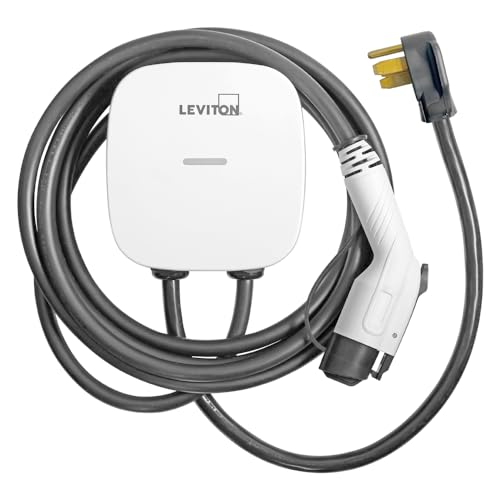
The Leviton EV40P is a plug-in Level 2 charger rated for 40 amps and 9.6 kilowatts. It comes from Leviton, a U.S. electrical-products brand best known for outlets and switches, and it pairs a NEMA 14-50 plug with a 25-foot J1772 cable and Wi-Fi control through the My Leviton app. It sits near the bottom of our ranking of eight, but that placement reflects its 40 A ceiling and shorter warranty, not a flaw. For the whole field, see our home EV charger rankings for 2026. The closest relatives are Leviton’s hardwired EV48W and the plug-in, no-Wi-Fi Grizzl-E Classic.
This profile draws on Leviton’s product page and public guidance on home charging, not on our own use of the charger, and we say where each fact comes from.
The Short Version
According to Leviton, the EV40P delivers 40 A at 208/240 V, which is 9.6 kW. It ships with a pre-attached 3-foot input cable that ends in a NEMA 14-50P plug, a mounting bracket and a 25-foot SAE J1772 charging cable. It connects over Wi-Fi to the My Leviton app, supports optional RFID access control, and is rated NEMA Type 3R for indoor or outdoor mounting.
It is a plug-in charger, so the real question is the receptacle on the wall behind it.
Key Specs According to Leviton
- Amperage and power: 40 A, 9.6 kW at 208/240 V AC.
- Breaker: 50 A.
- Connector and cable: SAE J1772, 25 feet (7.6 m).
- Input: Pre-attached 3-foot cord with a NEMA 14-50P plug.
- Wiring: L1, L2 and ground, bottom feed.
- Enclosure: NEMA Type 3R, plastic (PC+PBT).
- Operating temperature: minus 22 to 122 degrees Fahrenheit (minus 30 to 50 degrees Celsius), for both the unit and the charging cable.
- Altitude: Up to 6,500 feet.
- Status indicators: Power present, charging, fault.
- Standards listed: UL 2594, UL 2231-1, UL 2231-2, UL 2251, NFPA 70 Article 625, CSA C22.2 No. 280 and OCPP 1.6 compliance, among others.
- Wi-Fi: 802.11 b/g/n, with the My Leviton app.
- Warranty: Two-year limited.
Plug-In Versus Hardwired
The EV40P is the plug-in member of Leviton’s EV Series. The spec page lists related models: the EV32W (32 A), EV48W (48 A) and EV80W (80 A) are all described as hardwired only, while the EV40P is the one with the plug. The plug-in approach has an appeal: if you move, you can unplug it and take it along, and if the charger ever needs replacing, you are not reopening the wiring. Leviton also sells the matching EV charging receptacles, the 1450R and the weather-resistant 1450W, which the EV40P is listed as working with.
The tradeoff is power. Leviton’s specs match the common 40 A plug-in class: 9.6 kW, a 50 A breaker, and a NEMA 14-50 receptacle. A vehicle that can take 48 A will be limited to 40 A here. For most overnight charging that is not a problem, but if you want the top end, a 48 A hardwired model like the Leviton EV48W or the Tesla Universal Wall Connector is the alternative.
One note from the EPA’s guidance on home charging: it says chargers rated at 48 A or higher are usually required to be hardwired, while using an outlet lets you swap chargers without an electrician. That is the logic behind the 40 A plug-in class.
The Receptacle and Circuit Question
This is the section that decides whether the EV40P is right for your garage. The charger needs a dedicated 240 V circuit with a 50 A breaker and a NEMA 14-50 receptacle. The U.S. Department of Energy’s Alternative Fuels Data Center says EV charging equipment is considered a continuous load by the National Electrical Code and points to Article 625. The trade publication EC&M explains the 125 percent rule: size the branch circuit at 125 percent of the equipment’s maximum load. For 40 A, that is 50 A, which is exactly what Leviton lists.
If you do not already have a 14-50 receptacle on a dedicated circuit, a licensed electrician needs to install one, and many areas require a permit and inspection. The EPA says an electrician can run a load calculation to see whether your panel can handle the charger and can obtain the permits and inspections. San Diego County’s page says charger installations need a building permit, are inspected and must be completed by a licensed contractor. Check your local rules.
If you already have a 14-50 receptacle, do not assume it is ready for a charger. The EPA says you might not need an electrician if you have an outlet you are confident was properly installed, but whether an existing circuit, including a dryer or range circuit, can serve an EV charger is a decision for a licensed electrician who can look at the wiring, the breaker and the other loads. Never use a splitter or an adapter to share a circuit between an appliance and a charger.
Leviton also notes that for outdoor applications, the weatherproof receptacle must go in a 2-gang outdoor box with a code-compliant weatherproof cover. That is another reason to let an electrician handle the wall side of the installation.
Wi-Fi, App and Scheduling
According to Leviton, the EV40P works with the My Leviton app over Wi-Fi, and the same app can control Leviton’s smart switches, outlets and load center devices. The product page also lists optional RFID control. The practical value is scheduling: if your utility offers lower-cost overnight electricity, you can shift charging into that window. Check your utility’s rate plan for the hours.
Leviton also sells a smart high-current controller for homes with undersized service, described as certified to UL 3141 and meant to let an EV charger be added without affecting the panel’s load calculation. Nothing we consulted says how it would work with this charger, so ask your electrician whether it applies to your home.
Cable, Cold and Weather
The 25-foot cable is long enough for most single-car garages and many driveways, but measure from the receptacle to the charge port, remembering that the port can be on either side or at the rear. Leviton says the cable is designed to resist freezing and cracking in extreme weather, and lists an operating range down to minus 22 degrees Fahrenheit. The NEMA 3R enclosure is described as water resistant. The Department of Energy notes that outdoor installations require outdoor-rated equipment.
Pros and Cons
What stands out
- Plug-in design with a pre-attached NEMA 14-50P cord.
- 40 A and 9.6 kW, enough for an overnight charge on many EVs.
- 25-foot J1772 cable and a mounting bracket included.
- Wi-Fi, My Leviton app and optional RFID control.
- UL 2594 listed among the standards, from a well-known electrical brand.
What to weigh
- Needs a correct NEMA 14-50 receptacle on a dedicated circuit, which an electrician may have to install.
- 40 A ceiling.
- Two-year warranty.
- NACS adapter is a separate purchase.
How It Compares
Against the Grizzl-E Classic, which is also a 40 A plug-in on a 14-50, the Leviton adds Wi-Fi and an app. The Grizzl-E has no app at all and lists a NEMA 4 enclosure. Against the Leviton EV48W, you give up 8 amps and the hardwired design in exchange for a unit that unplugs. Against the Emporia EV Charger, which is also available in a 14-50 plug-in kit, the EV40P lists a shorter warranty (two years against three).
Who Should Buy It
This charger fits a homeowner who already has a good 14-50 circuit, or is willing to have one installed, and wants Wi-Fi scheduling without a hardwired install. It also fits an owner who may move and wants the option to take the charger along.
Who Should Skip It
Skip it if your car accepts more than 40 A and you want the faster charge, if you do not want to depend on a receptacle, or if you do not need Wi-Fi and would rather have a simpler unit.
Before You Buy
- Check your car’s maximum AC charging rate in the owner’s manual.
- Ask a licensed electrician about the circuit, the receptacle, the permit and any weatherproofing.
- Decide whether you need a NACS adapter, and check your vehicle maker’s guidance.
- Check your utility for rebates. Per the IRS, the federal section 30C credit does not apply to charging equipment placed in service after June 30, 2026.
You can check the current listing and price at Leviton EV40P on Amazon.
See how it compares with the other seven chargers in our EV charger rankings for 2026.
Sources